Making socks a different way
Jan. 18th, 2017 08:56 pm![[personal profile]](https://www.dreamwidth.org/img/silk/identity/user.png) altivo
altivoI've been busy making socks. Why not just buy them? Because when I make my own I get what I want, not what mass producers want to sell. For instance, I wanted some nice heavy and warm socks to wear inside my rubber work boots for barn stuff in winter.
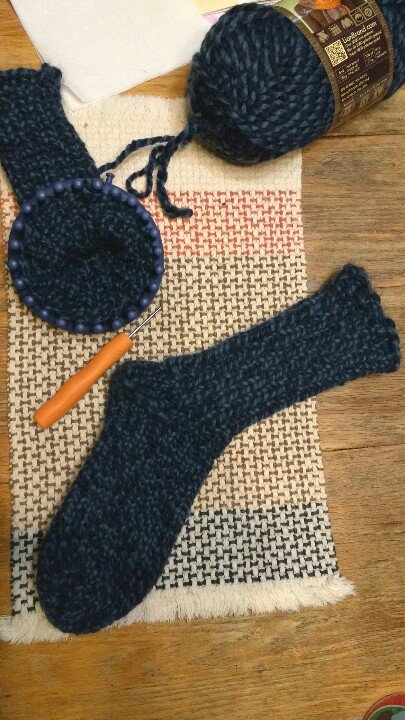 So here are the socks in progress. This is a super-bulky or "chunky" yarn, wool and acrylic blend. Though I am quite proficient at knitting socks in the conventional manner on double pointed needles, I'm doing these on a knitting frame (called a "loom" these days but I reserve that term for actual weaving equipment.) There are two reasons for that. The first one is that this rather stiff yarn calls for large diameter needles that I find clumsy to manipulate.
The second reason is more subjective. My husband has wanted to learn to knit for some time now, but has had little success with it. He finds the small precise motions involved difficult to execute in a consistent manner, even though he is quite proficient with a sewing machine or even a crochet hook. I keep reassuring him that it takes practice but he is impatient.
He asked for a sock loom for Christmas, so I got him the one he requested. It has a much finer gauge than the 24-pin hoop shown in the photo here, since it is designed for real sock yarn (about 1/32 inch in diameter as opposed to the 1/4 inch diameter of this chunky yarn.) He was having some difficulty getting started with it, so I pulled out my set of plastic hoop frames and suggested he try those first. The blue frame shown here is the smallest of the set of four, and he started with the next size up which has 28 pins. He produced a very attractive and evenly knitted scarf on that, a good seven feet long. It only took him about 3 days of working in odd moments.
As he was doing this I realized that even though I have taught knitting classes specifically on socks, I had no idea how to make a sock using a frame instead of needles. I figured I'd better learn before he went back to the sock loom and started asking questions. That's why I took the smallest frame and made a sock on it using some scrap worsted yarn. It worked, and only took about a day. The resulting sock is the right shape, but the stitch gauge was too loose for practical wear. These plastic hoops are really sized for bulky weight yarn.
That's when I remembered that I really wanted some heavy weight socks, so why not? I went to the craft store, bought a couple of balls of cheap bulky yarn, and here it is. The second sock is not yet finished, but I have turned the heel since taking this photo and will probably reach the toe sometime tomorrow if I have a loose hour or two. The one completed sock fits and will serve my purpose. It remains to be seen how durable they are, but at $4 for the yarn compared with almost $20 for any commercial product that even approaches what I want, it's worth the attempt. And yes, I'm now prepared to guide the novice frame knitter through the sock shaping process too.
So here are the socks in progress. This is a super-bulky or "chunky" yarn, wool and acrylic blend. Though I am quite proficient at knitting socks in the conventional manner on double pointed needles, I'm doing these on a knitting frame (called a "loom" these days but I reserve that term for actual weaving equipment.) There are two reasons for that. The first one is that this rather stiff yarn calls for large diameter needles that I find clumsy to manipulate.The second reason is more subjective. My husband has wanted to learn to knit for some time now, but has had little success with it. He finds the small precise motions involved difficult to execute in a consistent manner, even though he is quite proficient with a sewing machine or even a crochet hook. I keep reassuring him that it takes practice but he is impatient.
He asked for a sock loom for Christmas, so I got him the one he requested. It has a much finer gauge than the 24-pin hoop shown in the photo here, since it is designed for real sock yarn (about 1/32 inch in diameter as opposed to the 1/4 inch diameter of this chunky yarn.) He was having some difficulty getting started with it, so I pulled out my set of plastic hoop frames and suggested he try those first. The blue frame shown here is the smallest of the set of four, and he started with the next size up which has 28 pins. He produced a very attractive and evenly knitted scarf on that, a good seven feet long. It only took him about 3 days of working in odd moments.
As he was doing this I realized that even though I have taught knitting classes specifically on socks, I had no idea how to make a sock using a frame instead of needles. I figured I'd better learn before he went back to the sock loom and started asking questions. That's why I took the smallest frame and made a sock on it using some scrap worsted yarn. It worked, and only took about a day. The resulting sock is the right shape, but the stitch gauge was too loose for practical wear. These plastic hoops are really sized for bulky weight yarn.
That's when I remembered that I really wanted some heavy weight socks, so why not? I went to the craft store, bought a couple of balls of cheap bulky yarn, and here it is. The second sock is not yet finished, but I have turned the heel since taking this photo and will probably reach the toe sometime tomorrow if I have a loose hour or two. The one completed sock fits and will serve my purpose. It remains to be seen how durable they are, but at $4 for the yarn compared with almost $20 for any commercial product that even approaches what I want, it's worth the attempt. And yes, I'm now prepared to guide the novice frame knitter through the sock shaping process too.


no subject
Date: 2017-01-19 01:26 pm (UTC)no subject
Date: 2017-01-19 01:39 pm (UTC)The knitting loom, as it is called today, has been around for centuries. It allows you to produce textiles with the same structure as traditional needle knitting, but requires somewhat less dexterity. I think it is often used as physical or occupational therapy for that reason. Certainly the technique makes it easy to create simple items like scarves or afghans quickly and easily. Garments like mittens, socks, or sweaters require more shaping so there is rather more skill and planning needed but all are possible.
I suspect the main problem most people have with knitting is the fact that you are required to do a lot of small, repetitive actions in order to get results. It takes time, and may seem tedious. However, it can be done simultaneously with other activities, such as conversation or watching television. I often listen to an audiobook while knitting or spinning. My former boss and I used to knit while attending work-related meetings (which infuriates some people for reasons I don't quite understand, but since she persisted I felt perfectly comfortable doing the same.) Now that we are both retired, we no longer have that sort of fun.
Loom knitting is almost as portable as the regular needle knitting, at least when you are using a small loom. The larger looms for sweaters and blankets take up quite a bit of space.
no subject
Date: 2017-01-19 04:20 pm (UTC)no subject
Date: 2017-01-19 04:53 pm (UTC)no subject
Date: 2017-01-20 07:01 pm (UTC)no subject
Date: 2017-01-20 07:12 pm (UTC)no subject
Date: 2017-01-24 01:31 pm (UTC)no subject
Date: 2017-01-25 12:11 am (UTC)Facebook has at least one group of "Men Who Knit." (I'm not a Facebook user, but my husband is so I know about it.) The Ravelry website is also a good place to find instruction and advice as well as groups for men in particular.
A word of warning: Knitting is addictive to some of us. But it is also productive and soothing both. :D